VERSION 5.1, November 2020
CONTENTS PART 1
SCHEME OVERVIEW
1
Introduction
Ownership and Governance
Language
2
Features
2.1
Aim and Objectives
2.2
Nature of the Scheme
3
Scope
3.1
Farming of Animals (Category A)
3.2
Food Manufacturing (Category C)
3.3
Animal Feed Production (Category D)
3.4
Catering (Category E)
3.5
Retail and Wholesale (Category F)
3.6
Transport and Storage (Category G)
3.7
Production of Food Packaging and Packaging materials (Category I) .
3.8
Production of Biochemicals (Category K) .
3.9
FSSC 22000 - Quality .
1 INTRODUCTION簡介
1.1 THE SCHEME 方案
The FSSC 22000 certification scheme (hereafter the Scheme) outlines the requirements for the
audit and certification of food safety management systems (FSMS) or FSMS and Quality
Management Systems (QMS) of organizations in the food supply chain. The certificate confirms
that the organization’s FSMS (FSSC 22000) or FSMS and QMS (FSSC 22000-Quality) is in
conformance with the Scheme requirements.FSSC 22000 認證計劃(以下簡稱計劃)概述了以下要求 食品安全管理體系 (FSMS) 或 FSMS 和質量的審核和認證 食品供應鏈中組織的管理系統 (QMS)。證書確認 該組織的 FSMS (FSSC 22000) 或 FSMS 和 QMS(FSSC 22000-質量)處於 符合方案要求。
The Scheme is based on the publicly available standards/technical specifications:該方案基於公開可用的標準/技術規範:
•
• ISO 22000 requirements for any organization in the food chain;食品鏈中任何組織的ISO 22000 要求;
•
• ISO 9001 requirements (where FSSC 22000-Quality is required); ISO 9001 要求(需要 FSSC 22000-質量);
• Relevant prerequisite programs (PRPs) based on technical specifications for the sector (e.g.
ISO/TS 22002-x; PAS xyz); and• 基於行業技術規範的相關先決條件計劃 (PRP)(例如 ISO/TS 22002-x; PAS xyz);和 •
• FSSC 22000 Additional Requirements as determined by our stakeholders.由我們的利益相關者確定的 FSSC 22000 附加要求。
When the Foundation decides that updates or changes to the Scheme are necessary, requirements
for communication and implementation will be published separately.
當基金會決定有必要更新或更改方案時,要求 溝通和實施將另行發布。
The Scheme provides a voluntary certification model that can be applied across the entire food
supply chain. It can cover supply chain sectors where specific prerequisite programs (PRPs) have
been developed and accepted. The food chain category description used by this Scheme is defined
according to ISO/TS 22003:201 3 (see Chapter 3).該計劃提供了一種可應用於整個食品行業的自願認證模式 供應鏈。它可以涵蓋具有特定先決條件計劃 (PRP) 的供應鏈部門 被開發和接受。本方案使用的食物鏈類別描述定義 根據 ISO/TS 22003:201 3(見第 3 章)
As of February 201 0, the Scheme has been benchmarked and recognized by the Global Food Safety
Initiative (GFSI) confirming global food industry recognition and acceptance.
截至201年2月0日,該方案已獲得全球食品安全委員會對標和認可 倡議 (GFSI) 確認全球食品行業的認可和接受。
1.2 OWNERSHIP AND GOVERNANCE 所有權和治理
The Foundation FSSC 22000 (hereafter the Foundation) retains the ownership and the copyright
of all Scheme related documentation and also holds the agreements for all involved Certification
Bodies, Accreditation Bodies and Training Organizations.FSSC 22000 基金會(以下簡稱基金會)保留所有權和版權 所有與計劃相關的文件,還持有所有相關認證的協議 機構、認證機構和培訓機構。
The Foundation’s Statutes contain additional provisions and requirements regarding the
ownership of and governance over the Foundation and the Scheme. These Statutes are publicly
available in the Register of the Chamber of Commerce in Gorinchem, the Netherlands, under
number 641 1 2403. Such additional provisions and requirements are part of the Scheme in as far
as they may relate to the rights and obligations of direct and indirect stakeholders in the Scheme.基金會的章程包含有關的附加規定和要求 基金會和計劃的所有權和治理權。這些條例是公開的 可在荷蘭霍林赫姆商會的登記冊中找到 電話號碼 641 1 2403。此類附加條款和要求是計劃的一部分 因為它們可能與計劃中直接和間接利益相關者的權利和義務有關。
1.3 LANGUAGE 語言
English is the official and valid version of the Scheme. 英語是該計劃的正式有效版本。
2 FEATURES 特點
2.1 AIM AND OBJECTIVES 宗旨和目標
The aim of the Scheme is to ensure that it continuously meets international food industry
requirements resulting in a certification that assures that organizations provide safe food to its
customers.該計劃的目的是確保其不斷滿足國際食品行業 導致認證的要求,確保組織為其提供安全食品 顧客。
The specific Scheme objectives are to:具體計劃目標是:
a) Establish and maintain an accurate and reliable Register of certified organizations that
have demonstrated to comply with the Scheme requirements; 建立並維護準確可靠的認證組織登記冊 已證明符合方案要求;
b) Promote the accurate application of food safety and quality management systems; 促進食品安全和質量管理體系的準確應用;
c) Promote national and international recognition and general acceptance of food safety and
food safety quality management systems; 促進國家和國際對食品安全的認可和普遍接受,以及 食品安全質量管理體系;
d) Provide information and campaigns on food safety and quality management systems;
提供有關食品安全和質量管理體系的信息和活動;
e) Provide support for the certification of food safety management systems in the field of
food safety and quality.
為食品安全管理體系認證提供支持 食品安全和質量。
The Foundation endeavors to achieve these objectives by:基金會努力通過以下方式實現這些目標:
a) Entering into agreements with Certification Bodies, Accreditation Bodies and Training
Organizations;
與認證機構、認可機構和培訓機構簽訂協議 組織;
b) Taking appropriate measures in the event of abuse or improper use of the certificates
issued by licensed Certification Bodies or Training Organizations;
在證書被濫用或不當使用時採取適當措施 由持牌認證機構或培訓機構頒發;
c) Taking appropriate measures in the event of abuse or improper use of the Foundation's
FSSC 22000 logo; 在濫用或不當使用基金會的情況下採取適當措施 FSSC 22000 標識;
d) Supporting, supervising, and financing of other foundations and organizations which strive
to achieve similar or partially similar objectives as mentioned above.
支持、監督和資助其他致力於努力的基金會和組織 以實現與上述相似或部分相似的目標。
2.2 NATURE OF THE SCHEME 計劃的性質
The Scheme provides an independent ISO-based Scheme for third party auditing and certification.
The Scheme:該計劃為第三方審核和認證提供了一個獨立的基於 ISO 的計劃。 方案:
a) Incorporates ISO standards, sector specific technical specifications for PRPs, market driven
additional requirements as well as statutory and regulatory requirements;
納入 ISO 標準、行業特定的 PRP 技術規範、市場驅動 附加要求以及法律法規要求;。
b) Is recognized by the Global Food Safety Initiative; 得到全球食品安全倡議的認可;
c) Allows the integration with other management system standards such as those for quality,
environmental, health and safety etc.; 允許與其他管理體系標準整合,例如質量標準, 環境、健康和安全等;
d) Is governed by a non-profit Foundation and managed by an independent Board of
Stakeholders;
由非營利基金會管理,並由獨立的董事會管理 利益相關者;
e) Increases transparency throughout the food supply chain; 提高整個食品供應鏈的透明度;
f) Offers a “FSSC 22000 Register of certified organizations” which is publicly accessible.
提供可公開訪問的“FSSC 22000 認證組織登記冊”
3 SCOPE 範圍
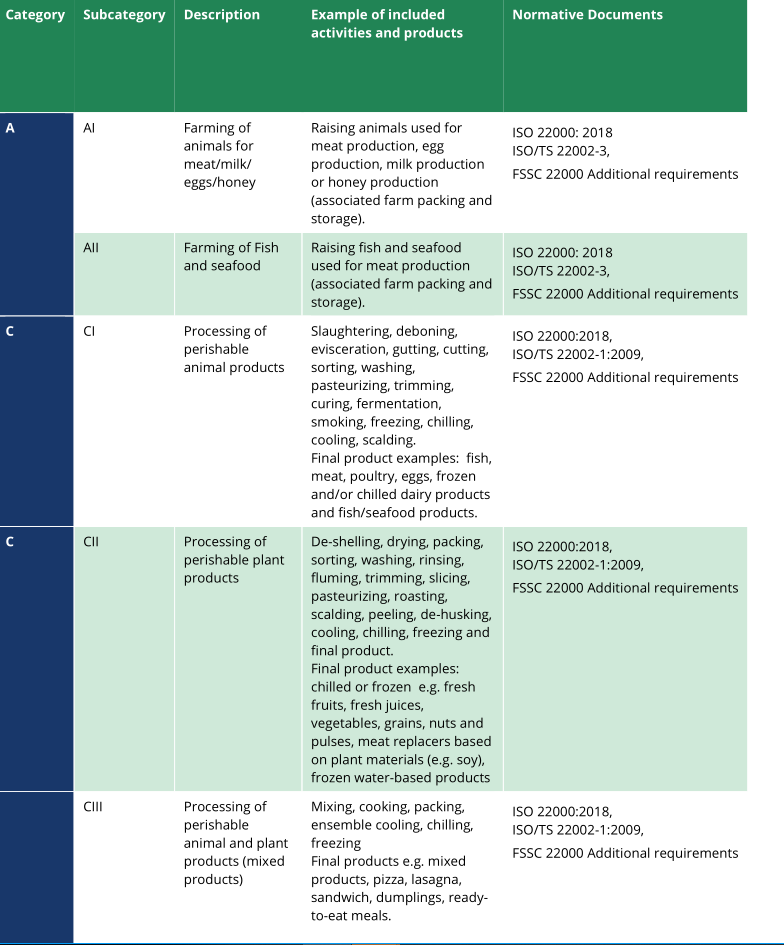
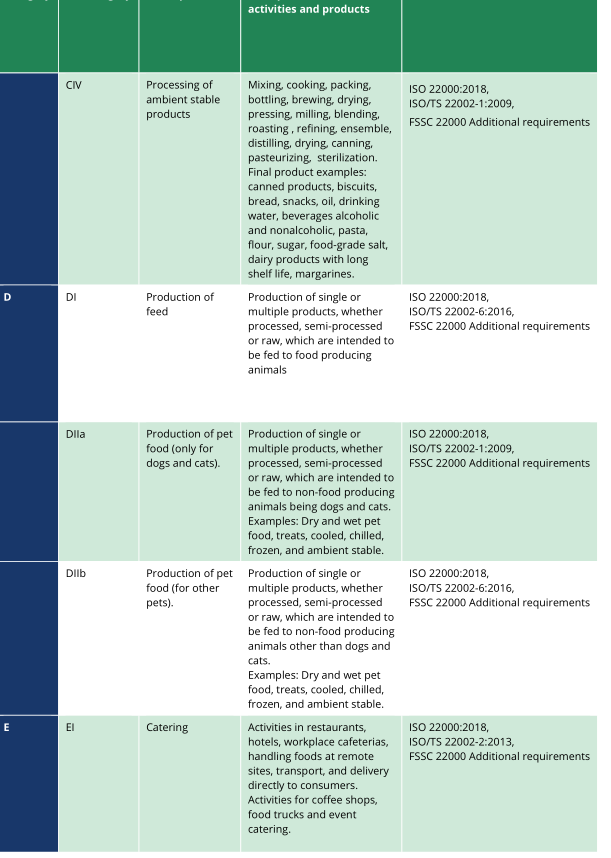
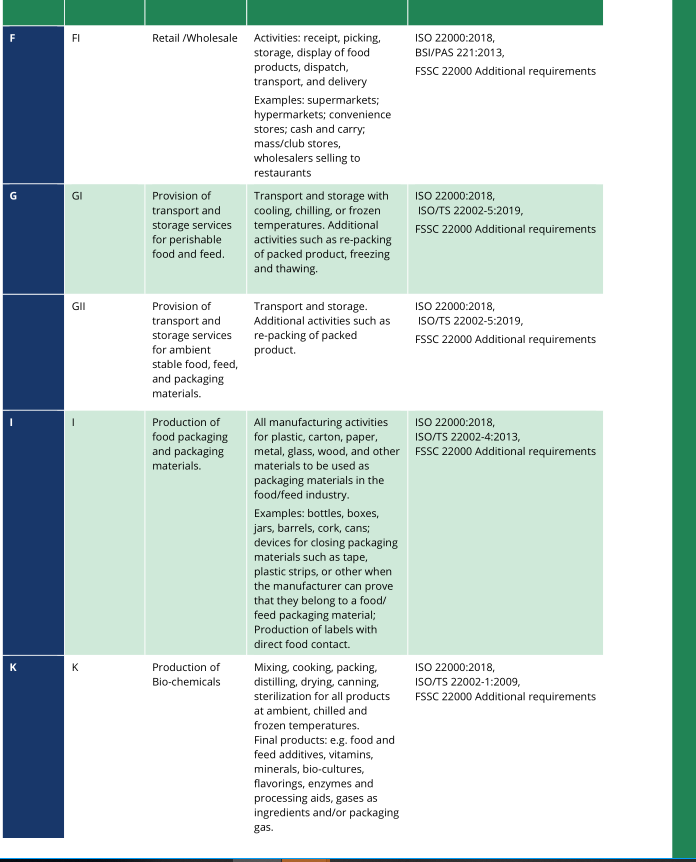
The Scheme is intended for the audit, certification, and registration of organizations for the
following food chain (sub)categories (in line with ISO/TS 22003:201 3; see also Table 1 ):
Table 1. Overview of (Sub)Categories
該計劃旨在對組織進行審核、認證和註冊 以下食物鏈(子類別(符合ISO/TS 22003:2013;另見表 1):表 1.(子)類別概述
3.1 FARMING OF ANIMALS (CATEGORY A)動物養殖(A 類)
Food chain subcategory AI refers to farming of livestock animals on land for human consumption.
Activities such as hunting, or trapping are not included.食物鍊子類別 AI 是指在陸地上養殖牲畜供人類消費。 不包括狩獵或誘捕等活動。
3.2 FOOD MANUFACTURING (CATEGORY C) 食品製造(C 類)
Food chain category C involves the following food processing activities:食品鏈 C 類涉及以下食品加工活動:
a) Processing of perishable animal products. Production of animal products including fish
and seafood, meat, eggs, dairy and fish products 易腐動物產品的加工。包括魚在內的動物產品的生產 以及海鮮、肉類、蛋類、乳製品和魚製品
b) Processing of perishable plant products. Production of plant products including fresh
fruits and fresh juices, vegetables, grains, nuts, and pulses, frozen water-based products
(e.g. ice) 易腐植物產品的加工。植物產品的生產,包括新鮮 水果和新鮮果汁、蔬菜、穀物、堅果和豆類、冷凍水基產品 (例如冰)
c) Processing of perishable animal and plant products. Production of mixed animal and plant
products including pizza, lasagna, sandwich, dumpling, ready-to-eat meals易腐爛動植物產品的加工。動植物混合生產 產品包括披薩、烤寬麵條、三明治、餃子、即食食品
d) Processing of ambient stable products Production of food products from any source that
are stored and sold at ambient temperature, including canned foods, biscuits, bread,
snacks, oil, drinking water, beverages, pasta, flour, sugar, food-grade salt.
環境穩定產品的加工在常溫下儲存和銷售,包括罐頭食品、餅乾、麵包、 零食、油、飲用水、飲料、意大利面、麵粉、糖、食品級鹽。
3.3 ANIMAL FEED PRODUCTION (CATEGORY D)動物飼料生產(D 類)
Food chain category D covers the production of animal feed and pet food:食物鏈類別 D 涵蓋動物飼料和寵物食品的生產:
a) Production of feed from a single or mixed food source, intended for food-producing
animals.
從單一或混合食物來源生產飼料,用於食品生產 動物。
b) Production of pet food (only for dogs and cats). Production of feed from a single or mixed
food source, intended for non-food producing animals.寵物食品生產(僅限狗和貓)。單一或混合飼料的生產 食物來源,用於非食物生產動物。
c) Production of pet food (for other pets). 寵物食品生產(其他寵物)
3.4 CATERING (CATEGORY E) 餐飲(E 類)
Food chain category E applies when the catering service is delivered to consumers. The food is
prepared at the place of consumption or at a satellite unit.
當餐飲服務交付給消費者時,食物鏈類別 E 適用。食物是 在消費地點或衛星單位準備。
Examples include:例子包括:
• Production units/kitchens that serve food directly to the consumer or offer food for
immediate consumption, e.g. restaurants, hotels, cafeterias;•
直接向消費者提供食品或為消費者提供食品的生產單位/廚房 立即消費,例如餐館、旅館、自助餐廳; •
• Catering handling foods at remote site with direct serving to consumers, e.g. canteens,
coffee shops, food trucks and event catering.
餐飲服務在遠程站點處理食品並直接服務於消費者,例如食堂, 咖啡店、快餐車和活動餐飲。
3.5 RETAIL AND WHOLESALE (CATEGORY F)零售和批發(F 類)
Food chain category FI applies to retail and wholesale activities.食品鏈類別 FI 適用於零售和批發活動。
Retail is defined as selling goods to the final customer (i.e. consumer), in small quantities for
consumption and not for the purpose of resale. Retailers shall have physical building and facilities
(i.e. shops). The retailer may offer internet sales or home deliveries that may be included in the
scope only when linked to the physical retail location but not as a stand-alone activity.
零售被定義為向最終客戶(即消費者)小批量銷售商品 消費,而不是為了轉售的目的。 零售商應有實體建築及設施 (即商店)。 零售商可以提供互聯網銷售或送貨上門,這些可能包含在 範圍僅在與實體零售地點相關聯時才適用,而不是作為一項獨立的活動。
Wholesale is defined as the buying of goods from manufacturers or other sellers and selling of
goods to other businesses like retailers, industries, and occasionally end consumers. The
wholesaler may offer internet sales or deliveries that may be included in the scope only when
linked to the physical wholesale location but not as a stand-alone activity.
批發被定義為從製造商或其他銷售商處購買商品並銷售 商品銷售給其他企業,如零售商、工業,有時甚至是最終消費者。 這 只有當 鏈接到物理批發位置,但不是一個獨立的活動。
Wholesalers always take ownership of the products and activities may include food, feed and/or
packaging products for food and feed.批發商始終擁有產品的所有權,活動可能包括食品、飼料和/或 食品和飼料的包裝產品
For both retail and wholesale, in-shop activities that only serve to give pre-prepared food a final
process step may be included (e.g. grilling of meat, bake-off of bread, cutting meat or fish).
對於零售和批發,店內活動僅用於為預先準備好的食品提供最終服務 可能包括加工步驟(例如烤肉、烤麵包、切肉或魚)
3.6 TRANSPORT AND STORAGE (CATEGORY G)運輸和儲存(G 類)
Food chain category G applies to third-party logistics service providers who physically store and/or
transport food, feed, or food/feed packaging materials, regardless of legal product ownership. It
may include additional activities such as re-packing of packed products, freezing and thawing
activities.食品鏈 G 類適用於實體存儲和/或 運輸食品、飼料或食品/飼料包裝材料,無論產品所有權是否合法。 它 可能包括額外的活動,例如包裝產品的重新包裝、冷凍和解凍 活動。
Manufacturers, caterers, or retailers/wholesalers that only store and/or transport their own
product(s) and do not provide a service to others shall be audited under the category linked to
their production activities.僅存儲和/或運輸自己的產品的製造商、餐飲服務商或零售商/批發商 產品且不向他人提供服務應在鏈接到的類別下進行審核 他們的生產活動。
3.7 PRODUCTION OF FOOD PACKAGING AND PACKAGING MATERIALS (CATEGORY I) 食品包裝生產及 包裝材料(第一類)
Food chain category I covers packaging that includes the production of food/feed packaging,
food/feed packaging materials and intermediate products for: 食物鏈類別 I 涵蓋的包裝包括食品/飼料包裝的生產, 食品/飼料包裝材料和中間產品,用於:
a) Direct food contact surfaces or materials (i.e. physically touching the food or in contact
with headspace) that will be in contact with the food during normal use of the food
packaging and/or;
直接接觸食品的表面或材料(即物理接觸食品或接觸食品 帶頂部空間),在正常使用食品期間會與食品接觸 包裝和/或;
b) Indirect food contact surfaces or materials that are not in direct contact with the food
during normal use of the food packaging, but there is the possibility for substances to be
transferred into the food.非直接接觸食品的間接食品接觸表面或材料 食品包裝在正常使用過程中,但物質有可能 轉移到食物中
Packaging material used for personal care, pharmacy or other uses are outside the scope of the
standard. Disposable tableware can only be certified when it is sold together (and as part of) the
food product. Examples are spoons that are packed with yoghurt, forks or chopsticks packed with
ready-to-eat food. The intended use, including that it is sold together (and as part of) the food
product, shall be clearly specified in the scope statement. 用於個人護理、藥房或其他用途的包裝材料不在本標準範圍內 標準。一次性餐具只有在與(或作為一部分)一起出售時才能獲得認證 食品。例如,裝有酸奶的勺子、裝有酸奶的叉子或筷子 即食食品預期用途,包括與食品一起(並作為食品的一部分)出售 產品,應在範圍說明書中明確規定。
3.8 PRODUCTION OF BIOCHEMICALS (CATEGORY K) 生化產品的生產(K 類)
Food chain category K involves the production of Bio-Chemicals and applies to the production of
food and feed additives, vitamins, minerals, bio-cultures, flavorings, enzymes, and processing
aids but excludes pesticides, drugs, fertilizers, and cleaning agents.食物鏈類別 K 涉及生物化學品的生產,適用於生產 食品和飼料添加劑、維生素、礦物質、生物培養物、調味劑、酶和加工 有幫助,但不包括殺蟲劑、藥物、肥料和清潔劑。
3.9 FSSC 22000 - QUALITY FSSC 22000 - 質量
FSSC 22000-Quality certification is a voluntary addition to the FSSC 22000 certification
requirements and supplements these requirements with all those of ISO 9001 :201 5 for Quality
Management Systems resulting in a FSSC 22000 certificate for the category FSSC 22000-Quality.
FSSC 22000-質量認證是對 FSSC 22000 認證的自願補充 要求,並用 ISO 9001 :201 5 的所有要求補充這些要求以確保質量 FSSC 22000 質量類別的 FSSC 22000 證書的管理系統。
The requirements for the development, implementation and maintenance of a quality
management system are laid down in the standard ISO 9001 :201 5 “Quality Management Systems
- Requirements”.質量開發、實施和維護的要求 ISO 9001 :201 5“質量管理體系”標準中規定了管理體系 - 要求”。